

Introduction
Many Intended Mothers (IMs) using donor egg surrogacy share a silent fear: that this child, from whom they lack a genetic link and did not carry, may never feel like theirs in full. In forums, comments, blog reflections, and qualitative research, women voice doubts, grief, and anxiety – not just at the obvious level (“Will I bond?”) but at more nuanced levels (worry that others will judge, that resemblance or personality will “betray” the donor, that the child might later resent them). This article shines a light on those fears and offers a hands-on, stepwise plan you can begin before birth to bond with your baby in donor egg surrogacy. Save it, share it, adapt it.
Part 1: Deep fears, voiced (some obvious, some less so)
Here’s a map of what IMs often fear, based on real comments, forums, and research. Understanding these helps your plan address the anxiety directly.
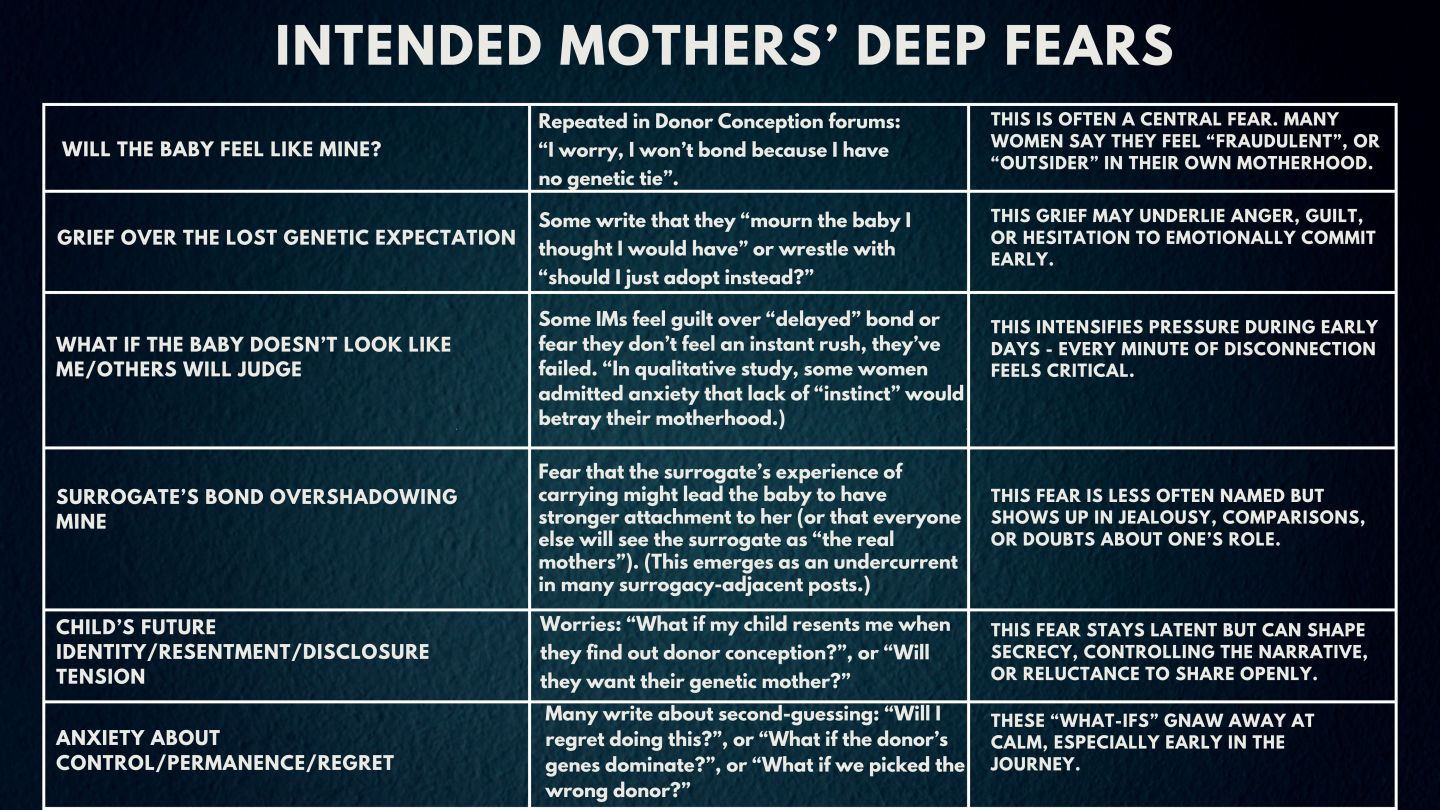
In “Making the Child Mine”, Imrie et al. explore how mothers in egg donation contexts engage in deliberate emotional work to “claim” the child as theirs – not by genetics, but through relationship, experience, narrative, and care.
Part 2: Step-by-Step Practical Plan to Build Emotional Connection (Pre-birth → Early months)
Below is a saveable, practical roadmap you (and your partner) can implement. Adapt timings and methods to your clinic, surrogate, and local context.
Stage 0: Preparation & mindset work (Even before embryo transfer)
Step 0.1 Acknowledge and journal your fears
- Write a letter to yourself (or to the unborn child) naming all your fears (the obvious and the whispery ones: bonding, resemblance, resentment, stigma).
- Revisit it weekly. Writing them down helps take the fears out of your head and makes them feel less overwhelming.
Step 0.2 Establish a collaborative relationship with the surrogate
- Early meeting (video or in person) to talk about roles, boundaries, and communication.
- Ask the surrogate how she feels about playing your voice or fairy tales for the baby and when it would be comfortable for her.
- Co-agree on a schedule: when and how you’ll send recordings or letters, how frequently she may update you, etc.
Step 0.3 Prepare your “emotional presence toolkit”
- Voice recordings: choose 3–5 short, simple texts (fairy tales, lullabies, greetings) you feel comfortable reading aloud.
- Letters / written messages: even 1–2 sentences per week to the baby (“I’m excited to meet you,” “I’m preparing your nursery today”) or to surrogate acknowledging her journey.
- Sensory tokens: a soft blanket, scarf, or small cloth from your home; maybe a “home scent” (unperfumed) to send to a surrogate to have near the womb.
- Visual mood board / photo collection: images of your planned nursery, family, hopes for the baby, that you look at daily.
Step 0.4 Personal support & therapy
- Work with a fertility-aware counselor or psychologist (ideally with experience in donor conception) to process shame, grief, identity.
- Join peer groups (online or in your country) of IMs who used donor eggs or surrogacy: hearing others’ stories normalizes your inner life.
Stage 1: Pregnancy period
(Even though you’re not carrying, you still have opportunities to “be present” to the baby and mindfully grow your emotional connection.)
Step 1.1 Scheduled recordings / voice contact
- Choose fixed days and times (for example, Monday evening, Wednesday morning, Friday night). Record your voice reading a short fairy tale, poem, lullaby, or sweet message.
- Label each file (e.g. Week 12 – Goodnight Star) so you build a consistent archive.
- Send them proactively (e.g., via a shared folder or a small USB card) to the surrogate, asking if she would play them (quietly) during restful times.
- Do at least 2–3 such recordings per week (or match surrogate’s comfort). Consistency over length.
Step 1.2 “Hello, little one” updates / letters
- Every week or two, write a short message: “This week I painted your wall; I chose blue and gold,” or “I held your blanket today and thought about you.”
- You may also send a photo of a nursery item or toy (if surrogate is comfortable).
- Occasionally include something for the surrogate: gratitude, encouragement, or asking how the baby is doing (in her respectful role).
Step 1.3 Sensory and symbolic link
- If the surrogate is comfortable, ask her to keep a small token (like a blanket or soft toy) nearby during calm moments. This simple ritual can help feel closer to your baby, even from afar.
- When recordings are played, the token may carry emotional resonance – baby may “hear your voice + smell/feel that object.”
- If the surrogate can share fetal images (ultrasound snapshots) nearly in real time, you can annotate them with little captions (“Here’s a tiny hand, I can’t wait to hold it”).
Step 1.4 Dialogue with surrogate about baby’s world
- Ask surrogate (if comfortable) small prompts: “When the baby kicks, where do you feel it most?”, “Which times seem more active?”
- These bits of experiential detail help you imagine a baby’s inside world (not just medical reports).
- Share your emotional reactions (e.g. “I felt tears when I heard you describe their first movement”). This fosters relational transparency.
Stage 2: Around Birth & Initial Contact
Here are emotional steps around birth you should plan.
Step 2.1 Curated “birth playlist / voice flashback”
- Prepare a mini playlist of 2–3 recordings (from your prenatal set) to play during early skin-to-skin or cuddling.
- Hearing your voice (familiar) can bridge the prenatal presence to postnatal bonding instantly.
Step 2.2 Photo + narrative link
- As soon as medical circumstances allow, ask for a photo (with medical staff’s cooperation or Senior Program Coordinator) of baby close to you (blanket, your hand, your scent token).
- Hold the baby with the token (scarf, cloth) you sent earlier, reinforcing your sensory link.
Step 2.3 Use your parent name & narrative cues
- From minute one, speak to the baby with your chosen name (“Mom,” “Mama,” etc.). Use the same name you used in your recordings and letters.
- Narrate: “You are home now.” This helps your own mind and baby’s nascent memory connect your identity to them.
Stage 3: Postnatal period → First months
Step 3.1 Continue voice & story ritual
- Maintain a daily short voice check (or reading) during cuddle/wake/feed times.
- Occasionally say, “This is the same story I read you when you were in the womb,” reinforcing continuity.
Step 3.2 Skin contact, eye contact, paced feeding
- Continue generous skin-to-skin time, baby wearing close to your scent, and holding during feeds (even if bottle-fed).
- Slow, responsive feeding (pause, eye contact) helps the baby see you as the source of comfort.
Step 3.3 Build ritual traditions
- Choose small rituals (e.g. bedtime song, soft hand-holding ritual, a “first smile journal”) and repeat them nightly.
- Rituals embed emotional predictability into daily life, reinforcing your presence.
Step 3.4 Photo/voice archive for reflection
- Save all recordings, letters, and photos in one album (digital + optional printed book).
- Over time, revisit them when doubts arise – seeing your archive is proof of your emotional investment.
Step 3.5 Prepare your disclosure plan (when to tell)
- With your therapist or support group, begin drafting age-appropriate wording to tell the child about donor conception when the time is right.
- Rehearse it out loud. Clarity and confidence in your narrative reduces anxiety and reinforces your role as the chosen parent, not a hidden one.
Conclusion & Why This Works
- Naming fears aloud takes their invisible power away.
- Regular voice and sensory rituals help the baby start recognising and remembering you even before birth.
- Collaborative relationship with the surrogate ensures respect and emotional safety on both sides.
- Postnatal continuity (same recordings, same name, same rituals) bridges the prenatal bond into real life.
- On days you doubt, looking back at your recordings and rituals will remind you how much love and care you’ve already given.